How to build client loyalty in your salon: the complete guide in 7 levers
Retention always costs less than acquisition. Discover 7 concrete levers to turn every first salon visit into a regular appointment.
By Déborah · June 2, 2026
Keeping an existing client always costs less, in time and energy, than attracting a new one. And yet, in the salon world, we often spend most of our time filling the calendar with new faces instead of turning a first visit into a regular appointment. Here are 7 concrete levers, ready to apply this week, to build lasting loyalty with your clients.
Why loyalty changes everything for your business
A loyal client doesn't just come back: she leaves positive reviews, recommends your salon without being asked, and is more open to trying new services because she already trusts you. A client who only visits once, on the other hand, forces you to keep repeating the acquisition effort — the most costly one of all, in prospecting time as much as in ad spend.
The good news: loyalty almost never depends on pure technique. It depends on the overall experience your client lives through, from the first booking message to the moment she walks out the door. That's the experience you need to build, lever by lever.
The 7 concrete levers for lasting loyalty
1. Take care of the first few seconds
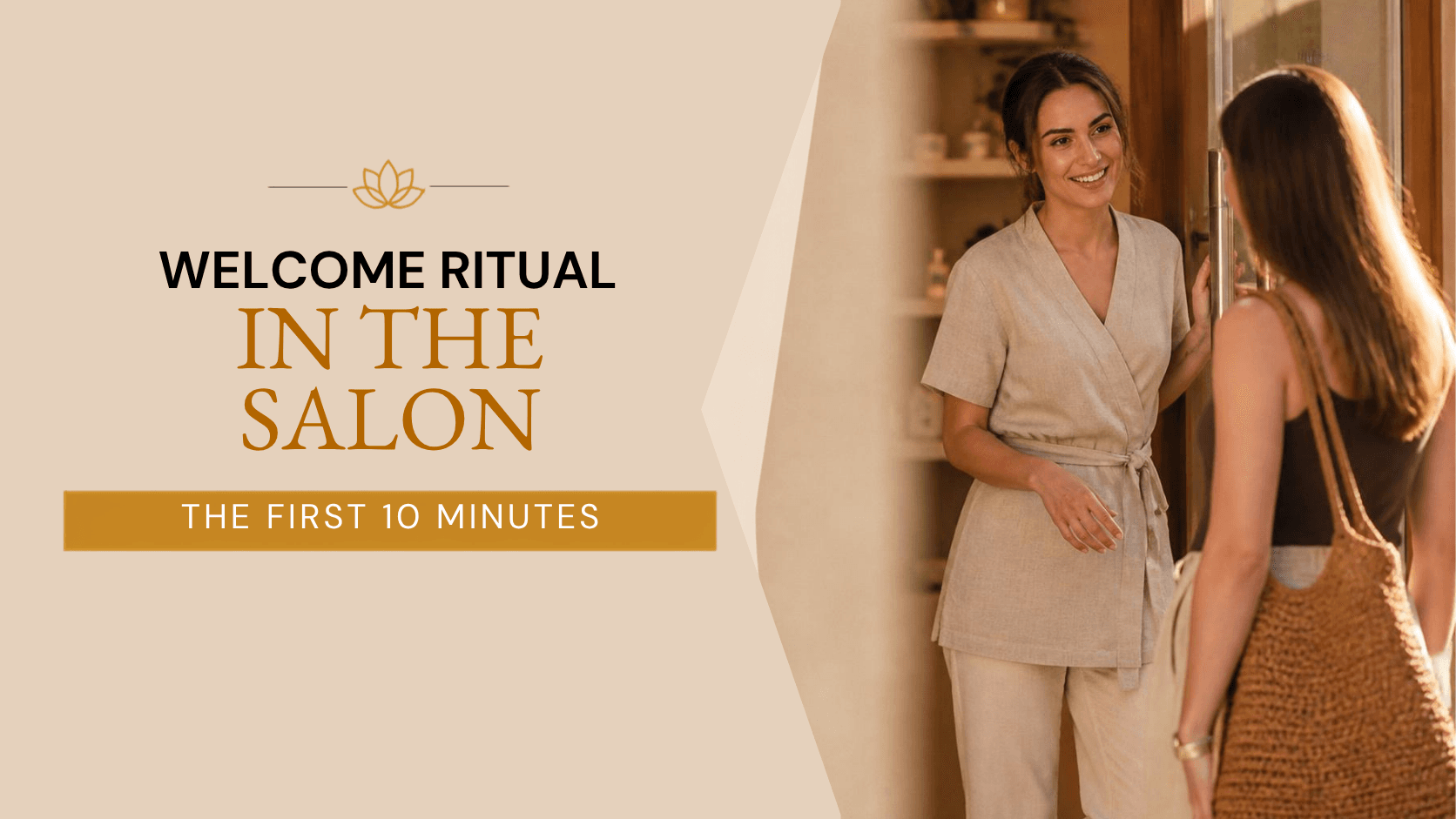
Loyalty begins at the welcome, well before the treatment starts. A genuine smile, a warm drink offered, soft lighting, a pleasant scent in the room: these details immediately build a sense of trust and wellbeing. Your client should feel she's stepping into a moment of escape, not a medical appointment run on a conveyor belt.
This first contact largely sets the mindset she'll carry through the rest of the treatment — a rushed or distracted welcome, even followed by an excellent massage, leaves a mixed impression overall.
In my own practice, offering tea or a glass of water (with a small piece of chocolate) at the end of the treatment isn't optional — it's a systematic reflex. It sounds trivial, but giving your client those few minutes to resurface before she leaves genuinely changes how she experiences the end of the appointment — especially if she feels she can actually take that time, instead of being nudged out by the next client.
2. Personalise every treatment
Nothing builds loyalty like the feeling of being treated as a unique person, not a slot in a schedule. Take 2 to 3 minutes at the start of the session for a real assessment: current stress level, tension she's feeling, sleep quality, goals for this specific appointment. Then visibly adapt your protocol based on her answers — and say it out loud: "Since you mentioned you're not sleeping well, I'll focus on relaxing the upper part of your face."
Your client then understands that this treatment was designed specifically for her, on that day — not simply run through a fixed template.
One habit I recommend to every esthetician I train: after each appointment, jot down one personal detail your client shared — an upcoming holiday, something stressful at work, a preference for one oil over another. Keep it in a client file, even a basic one. Then, at the next appointment, bring it back up ("So, how was the trip?"). It's a tiny thing to put in place, but it's exactly what makes a client feel genuinely recognised — not just served.
3. Create a recognisable ritual
A signature movement, a dedicated piece of music, a closing phrase that's always the same: these markers create a ritual your client associates with you alone, and no one else. This is the heart of the ORA method — a treatment found nowhere else, precisely because it carries your signature. (You'll find a full method for building this ritual in our guide on how to create a signature treatment.)
4. End with a clear recommendation
At the end of the treatment, don't let your client leave without a concrete plan. Offer a clear frequency: "To extend the results, I'd recommend coming back in 4 weeks — that's usually when tension starts to return." A client who leaves with an approximate date in mind, and ideally an appointment already booked, comes back noticeably more often than one who leaves with no guidance.
5. Keep the connection between appointments
A short message a few days after the treatment ("How is your skin feeling since our session?") shows you're thinking of her outside a purely commercial frame. This small, human gesture, which takes two minutes, makes all the difference next to a salon perceived as impersonal. Be careful not to turn this follow-up into a disguised sales pitch: the intention needs to stay genuine.
6. Reward loyalty
A loyalty card, a complimentary treatment after a certain number of sessions, priority access to new offerings or the most in-demand slots: give a tangible reason to come back to you rather than try another salon. The reward doesn't need to be expensive — it mostly needs to be visible and consistent, so the client keeps it in mind.
7. Turn your clients into ambassadors
A delighted client talks about you spontaneously to the people around her. Encourage this word of mouth with a small perk for every friend she refers who actually books an appointment. It's by far the most cost-effective acquisition channel there is — because a personal recommendation inspires far more trust than an ad ever could.
In the same spirit, never hesitate to directly ask a satisfied client for an online review — many estheticians shy away from it, out of modesty, when most clients are genuinely happy to leave one if they enjoyed the treatment. A simple QR code displayed in the room, pointing to your Google listing, is enough: offer it naturally while she's enjoying her tea at the end of the appointment (lever 1). These reviews feed directly into loyalty and word of mouth — and, as a bonus, give you a concrete argument the day you decide to raise your prices.
Building loyalty isn't about stacking up promotions. It's about offering an experience so personal that it becomes impossible to do without.
The mistakes that break loyalty
Stacking up permanent discounts. A systematic discount devalues how the treatment is perceived and attracts a clientele that's only price-sensitive — the kind that leaves for the first better offer elsewhere. Save pricing perks for loyalty rewards (lever 6), not for ongoing acquisition.
Lacking consistency in the experience. If the welcome, the ritual or the quality of the treatment vary too much from one visit to the next, your client can't build stable trust. Loyalty is fed by regularity, not isolated peaks of quality.
Never asking for feedback. Many estheticians don't dare ask a client directly whether she was satisfied, out of fear of the answer. Yet this question, asked simply at the end of the treatment, lets you correct course immediately instead of silently losing the client.
Not training your team on the welcome. If you work with other practitioners, the experience needs to stay consistent regardless of who receives the client. A warm welcome from one person and a rushed one from another breaks the trust built with the salon as a whole.
The role of the nervous system in how the experience is remembered
An often overlooked point: a client who experiences a treatment in a stressed or tense state keeps a blurrier, less positive memory of it, even if the technical protocol was flawless. This is one of the founding principles of the ORA Restore & Reconnect method — regulating the nervous system before starting the treatment directly changes the quality of the memory the client keeps, and therefore how likely she is to return.
In practice: a few guided breaths, a calm transition between the welcome and settling into the treatment room, a steady tone of voice throughout the appointment. These are simple adjustments that don't lengthen the treatment, but transform how it's remembered.
FAQ — Client loyalty in beauty salons
How do you actually measure your client retention? The simplest way is to track your return rate: out of 10 new clients seen in a given month, how many book again within the next 2 to 3 months? Most booking software makes this figure easy to pull and track over time.
Do you need special software for a loyalty programme? Not necessarily at the start: a physical stamped card works very well to begin with. A digital tool becomes useful mainly once your client volume grows and manually tracking perks becomes difficult.
How do you reach out to a client who hasn't been back in a while? Send a personalised message rather than a generic promotion: remind her of the last treatment she received, show that you remember her, and simply offer to rebook — without pressure. A sincere outreach often works better than a commercial offer.
Should discounts be avoided entirely? No, but they should stay occasional and targeted (salon anniversary, launch of a new treatment) rather than permanent. The key is that they should never become the main reason a client chooses to come back.
In short
Loyalty relies less on pure technique than on the overall emotional experience your client lives, from the first contact to the next appointment already booked. That's exactly what the ORA Restore & Reconnect method teaches you to build, treatment after treatment.
Want to go further? Discover how to increase your average spend without pushing the sale, or download Chapter 1 of the ebook “Elevate Your Client Experience”, free: everything that happens before the first contact and actually makes clients come back.