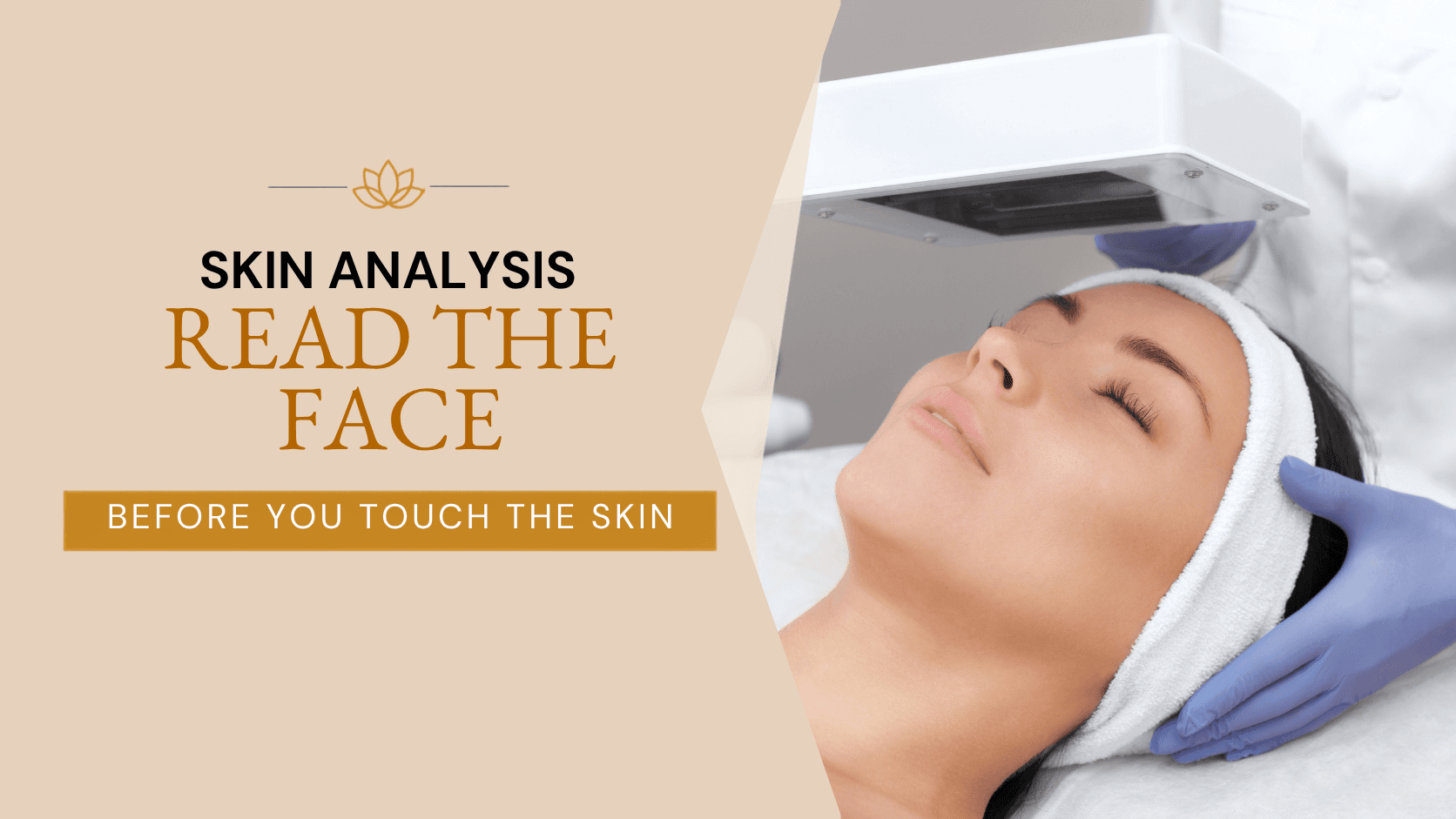
Facial lymphatic drainage: technique, benefits and mistakes
Facial lymphatic drainage decongests features and calms the whole system. Here is the step-by-step technique, its real benefits and the mistakes to avoid.
By Déborah · August 10, 2026
There is a moment I love in the treatment room: the one where a client sits up after a drainage session and looks at herself in the mirror without saying anything for a few seconds. That is not magic, it is physiology — and it is also, very often, a misunderstood technique. Facial lymphatic drainage is probably the most poorly executed movement in our whole profession: too much pressure, too fast, too short. Here is what it actually does, how to perform it properly, and what stops it from working.
What facial lymphatic drainage actually does
Lymph is a clear fluid circulating through a network that runs parallel to the blood system. Its job: clearing cellular waste, excess interstitial fluid and part of what the body cannot eliminate any other way. One major difference from blood: lymph has no pump. There is no lymphatic heart. It moves thanks to muscle contractions, breathing… and our hands.
On the face, that network is unusually dense and unusually superficial. It runs a few tenths of a millimetre below the skin. That is the whole subtlety of the movement: where a classic massage looks for muscle, drainage looks for the skin itself. You are not working into the tissue, you are moving it.
In practice, good drainage sends stagnant fluid back towards the lymph nodes, where it gets filtered. The visible result — decongested features, an open eye area, a sharper jawline — is not a cosmetic illusion. It is a volume of fluid that has genuinely left the area.
The real benefits — and the oversold ones
After ten years of practising this technique in the treatment room, I have learned to separate what it truly delivers from what marketing attributes to it.
What is real and observable:
- Decongestion. This is the main and most immediate effect. Under-eye puffiness, heavy lids, a swollen face on waking, hormonal or salt-related swelling: drainage acts on all of it in a single session.
- A sharper jawline. By decongesting the mandibular area and the neck, you redraw a line that fluid retention had blurred.
- Brighter skin. Less stagnation, better microcirculation: the complexion looks more alive, less grey.
- A calmer nervous system. The slow, repetitive rhythm of drainage is in itself a safety signal for the body. Many of my clients fall asleep on the table.
- Genuine comfort after surgery or injections — with medical clearance, never on your own initiative.
What it does not do:
It does not "detox" the body in the way social media suggests — the liver and kidneys handle that. It does not dissolve fat. It does not replace medical treatment for lymphoedema. And most importantly, the effect is not permanent: it is maintenance, not a lasting transformation.
Saying that honestly to your client is not underselling yourself. It is the exact opposite: a practitioner who knows where her technique stops is far more credible than one who promises everything.
A quick anatomy map: where facial lymph goes
You cannot drain well without knowing where you are sending the fluid. This is the point I have to revisit most often in training, because many estheticians have learned a sequence of movements without ever having seen the map.
Three landmarks are enough to work correctly:
- The supraclavicular nodes, in the hollow of the collarbones. This is the terminus. Everything ends there.
- The cervical nodes, running along the neck muscles from the ear down to the collarbone. This is the motorway heading down.
- The pre-auricular and submandibular nodes, in front of the ear and under the jaw. These are the collectors for the face.
The logic of drainage follows directly from that map: you always empty before you fill. You open the lower nodes (collarbones, neck) before touching the face at all. Otherwise you are pushing fluid towards a closed exit — and you end up with a face more congested than when you started. That is mistake number one, and it is the most common one by far.
The technique step by step: drainage in six stages
Here is the framework I use in the treatment room. The principle governing everything: very light pressure, slow rhythm, repeated movement. Roughly 20 to 30 grams of pressure — the weight of a coin resting on the skin. If the skin slides under your fingers, you are pressing too hard.
1. Rest your hands before you begin
Before any technical movement, spend a few seconds in still contact on the face or shoulders. It looks like nothing. In reality, this is what tips your client's nervous system into parasympathetic mode — and a relaxed nervous system means tissue that lets itself be drained. On a tense client with a clenched jaw, you would be draining against her.
2. Open the terminus
Slow, gentle pressures in the hollow of the collarbones, five to seven times. Then along the neck, top to bottom, at the same pace. You are not rubbing: you stretch the skin downwards, release, and start again in the same spot.
3. Free the neck
Downward movements on the sides of the neck, from the angle of the jaw towards the collarbone. This is the compulsory passage. Take your time here — a good two minutes — even though it is the area clients look forward to the least.
4. Drain the lower face
Jawline, mandible, chin. The movement starts at the centre of the chin, travels along the jaw towards the pre-auricular nodes, then comes back down the neck. Always the same circuit, always the same direction.
5. Move up to the eyes and forehead
This is the thinnest zone, and where you soften the pressure even further. Around the eye, the movement goes from the inner corner towards the temple, never the reverse. On the forehead, from the centre outwards to the temples, then the temples drain back down towards the ear and neck.
6. Close the loop
Always finish by retracing the full path, top to bottom, down to the collarbones. That final loop evacuates what you have mobilised. Skipping it means leaving the work half done.
Facial lymphatic drainage is not judged by the strength of the movement, but by the patience of the hand. It is a technique where you get more by pressing less.
Allow at least 20 minutes for a complete, effective drainage. Below that, you are performing a pleasant introduction, not a drainage.
Five mistakes that cancel out the whole effect
Pressing too hard. The king of mistakes. Firm pressure crushes the superficial lymphatic capillaries instead of stimulating them — you are blocking exactly what you are trying to get moving. If your client says "it feels lovely but I can barely feel it," that is a good sign.
Working too fast. The lymphatic system has its own rhythm, roughly six to ten contractions per minute. A quick movement literally misses it. Slow down until it feels almost too slow: that is where you want to be.
Starting with the face. As we saw: without opening the neck and collarbone nodes first, you are pushing fluid towards a closed door.
Using too much product. Excess oil makes your hand slide over the skin instead of carrying it along. Drainage needs grip. Work on clean skin with the barest touch of a fluid serum — or completely dry, as I often do.
Not explaining what you are doing. A client used to firm massage may find drainage "too light" if nobody told her why. Thirty seconds of explanation before you start completely changes how she perceives the treatment. I put this in the same family as the errors covered in my article on the most common facial massage mistakes: the hand is not the problem, the framing around the movement is.
Contraindications: when not to drain
Drainage is gentle, but it is not trivial — it moves fluid and engages the immune system. Skip it in cases of acute infection or fever, local inflammation (infected acne flare-up, active cold sore), active cancer or a history of it without medical clearance, thrombosis, unstable cardiac or kidney conditions, and unmonitored thyroid disorders. When in doubt, postpone and refer to a doctor. That is the most professional reflex there is.
Drainage inside the ORA Restore & Reconnect method
In my practice, facial lymphatic drainage is never a standalone service sitting on a price list. It belongs to a wider logic — the ORA Restore & Reconnect method: regulate the nervous system first, observe before touching, then adapt the technique to what the face is telling you that day.
Why that order? Because lymphatic circulation depends directly on how tense the body is. A client in alert mode breathes high in the chest, with raised shoulders and a clenched jaw — three conditions that mechanically obstruct lymphatic return. Starting with a few guided breaths and a grounding moment is not a wellness extra: it is what makes the drainage genuinely effective on a physiological level.
That is also why I rarely recommend selling drainage on its own. Built into a coherent protocol — regulation, reading the face, drainage, sculpting work, closing ritual — it becomes a pillar of the treatment, exactly the logic behind a signature treatment built on a clear promise.
How many sessions, and how often
This question comes up every single time. My answer depends on the goal.
For a one-off need — an event, a puffy face after a hard stretch — a single session is enough to see a result, visible immediately and holding for two to three days.
For deeper work on chronic retention, I suggest a course of treatments: one session a week for four to six weeks, then monthly maintenance. That is where consistency pays off, and it is also what builds a loyal client base rather than a string of isolated visits.
Between sessions, teach your client two or three simple movements to do at home, thirty seconds each morning. She extends the benefit, and she thinks of you every morning. Hard to find a better reminder than that.
FAQ — Facial lymphatic drainage
How quickly do results show? Immediately, by the end of the session, on puffiness and the jawline. The effect is even more marked the next morning. On long-standing retention, several closely spaced sessions are needed before the change holds.
Does facial lymphatic drainage slim the face? No. It moves fluid, not fat. A face can look slimmer after a session because it is decongested, but no adipose tissue has been affected. That is an important distinction to set out clearly with your client.
Can it be done on sensitive or reactive skin? Yes — and it is often one of the few manual techniques suited to those skin types, precisely because the pressure is minimal and there is no friction or heat. It is frequently better tolerated than a classic massage.
Do I need a specific certification to offer it in a salon? Aesthetic facial drainage falls under wellbeing treatments and is not a medical act, unlike therapeutic drainage performed by physiotherapists on referral. Rules vary by country, so check your local regulations. Solid training remains essential regardless — not for legal cover, but because poorly executed drainage delivers no result at all.
Can it be combined with a device or a tool? Rollers, gua sha, radiofrequency: these are complements, not substitutes. No tool matches the adaptive sensitivity of the hand, which feels tissue resistance in real time and adjusts. Use them at the end of your protocol if you like, never in place of the manual work.
Going further
Drainage is a technique that transfers badly through writing: it is a matter of hand, pressure and rhythm. If you want to build it into a complete protocol — with nervous system regulation, reading the face and the personalised massage that surrounds it — that is exactly what you will find in the ORA Restore & Reconnect training.
For a simpler starting point, get the free guide: you will find keys you can apply with your very next client. And if you want to work on your wider offer, read how to build lasting client loyalty in your salon.