Advanced facial massage training: how to choose the right one
Prerequisites, content, format, certification: the complete method to choose an advanced facial massage training that genuinely transforms your practice.
By Déborah · August 5, 2026
You've already mastered the basics of facial massage, your clients keep coming back — and yet something still feels missing. That's exactly the moment an advanced training makes sense, provided you choose the right one. Here's how to recognise genuine advanced facial massage training, know whether you're ready for it, and avoid the courses that will only hand you one more protocol.
What "advanced" actually means
In the esthetics world, "advanced" has become a marketing word. It gets attached to trainings that are, in reality, just another variation on a protocol you already know: different sequences, a different name, sometimes a different country of origin — but the same underlying logic.
Genuinely advanced training doesn't teach you more movements. It teaches you to decide: which movement, on whom, at what moment, at what intensity, and above all why. It's a change of level, not an addition of content.
In practice, you move from "I know a 60-minute protocol" to "I can build a 60-minute treatment from what I observe on this particular client, today". That's the difference between executing and practising.
After fifteen years in the treatment room and a long list of trainings — Kobido, lymphatic drainage, deep tissue, remodelling — that's the lesson that cost me the most time: I spent years convinced a technique was missing. What was actually missing was a framework for choosing between the ones I already knew.
Are you ready for advanced training? 5 telling signs
Advanced training taken too early is wasted money — not because the course is bad, but because you're missing the reference points to make anything of it. Here are the signs the moment has come.
1. Your protocol runs smoothly, but you're a little bored
You could do it with your eyes closed. Technically, that's a good sign — and it's precisely the floor you need in order to build on top of it. As long as your hands are still thinking, your head isn't free to observe.
2. You see differences between clients your protocol can't handle
A locked jaw, a highly reactive face, a client who never fully relaxes despite a flawless treatment. You can see the problem, you don't yet have the tool to address it. That's the best possible moment to train.
3. Your results are good but inconsistent
Some treatments are extraordinary, others merely fine — and you can't really explain why. Inconsistency is almost always the sign that a key factor (assessment, regulation, pace) is being left to chance instead of steered.
4. You want to move upmarket and don't quite dare
You sense your treatment is worth more than your current price, but you couldn't explain precisely what makes it different. Advanced training gives you the real substance behind moving upmarket — and therefore the legitimacy to own it.
5. You're starting to train "for reassurance"
Watch out for this one: if you're stacking up courses without your practice actually changing, technique is no longer what's missing. Advanced training should answer a specific question you're asking yourself in the treatment room, not a vague feeling of not knowing enough.
The 6 pillars of genuine advanced facial massage training
When you compare two programmes, don't compare the number of hours or the number of manoeuvres taught. Compare the presence of these six pillars.
1. A real assessment protocol
Not "look at your client's skin", but a structured method: what to observe, in what order, which questions to ask, how to read tension through palpation, and how to translate all of it into treatment decisions. If the training has no assessment module in its own right, it isn't advanced.
2. Preparing and regulating the nervous system
This is the pillar most often missing — and the one that changes results the most. A face whose nervous system is on alert won't release, no matter how good your manoeuvres are. Advanced training teaches you to establish safety before you massage: breathing, the pace of your opening, your voice, the first contact, the environment.
3. Anatomy applied, not recited
The difference between knowing the names of the muscles and knowing what a contracted masseter does to the contour of the face. Look for anatomy taught from the question "what do I do with this information under my fingers?".
4. Real-time adaptation
The ability to change your treatment while it's happening, based on the body's responses: breathing that deepens or catches, a muscle that yields or resists, an area that flushes. It's the hardest skill to transmit — which makes it the best marker of a serious training.
5. Building your own treatment
Advanced training should leave you able to build your own protocols, not just reproduce someone else's. If you come out with a fixed sequence to apply identically every time, you've bought a protocol, not a method.
6. Support after the training
The real learning starts when you go back to the treatment room and your first client doesn't respond the way the demonstration did. A training that leaves you alone at that moment loses 80% of its value. Look at what's planned: Q&A, feedback on your practice, long-term access to the content.
Advanced training isn't judged by the number of movements you bring home, but by the number of decisions you can then make on your own.
In person, online or hybrid: which format to choose
Each format has a genuine logic, and the "online means less serious" debate is outdated — as long as you're looking at the right thing.
- In person excels at correcting the gesture itself: someone places their hand on yours and adjusts your pressure. Irreplaceable for the first technical level. Its limits: cost, travel, and above all density — two intense days, a large part of which you'll forget within three weeks.
- Online excels at everything that needs repetition and hindsight: rewatching a manoeuvre ten times, coming back to the assessment module six months later when the question actually arises in the treatment room. It's the format that best matches how a method is genuinely absorbed.
- Hybrid combines both where possible, but tends to be more expensive and harder to fit into a schedule.
The criterion that matters more than the format: will you be able to come back to the content when you need it? A training you can't revisit is a training you forget.
The 5 questions to ask before you enrol
Write them down and actually ask them. A serious trainer answers them willingly; a vague answer is already an answer.
- What will I be able to do at the end that I can't do today? The answer should be a skill, not a content list.
- How does the treatment adapt to a client who doesn't fit the standard case? You're testing for the "adaptation" pillar.
- How long do I have access to the content, and what happens if I have a question in three months?
- What's the trainer's treatment-room experience, and are they still practising? A method that hasn't met real clients recently ages quickly.
- Is there a certificate, and what exactly does it cover? In esthetics, a certificate's value comes from the method behind it, not the paper itself — check what's actually there.
What advanced training changes in the treatment room
The benefits aren't only technical, and that's often what gets underestimated when you're working out whether the investment is worth it.
- More consistent results. You stop depending on the "right client" or the right day, because you're steering the factors that make the difference.
- A clear way of describing what you do. Being able to explain your approach in three sentences completely changes how your treatment is perceived — and makes moving upmarket obvious instead of awkward.
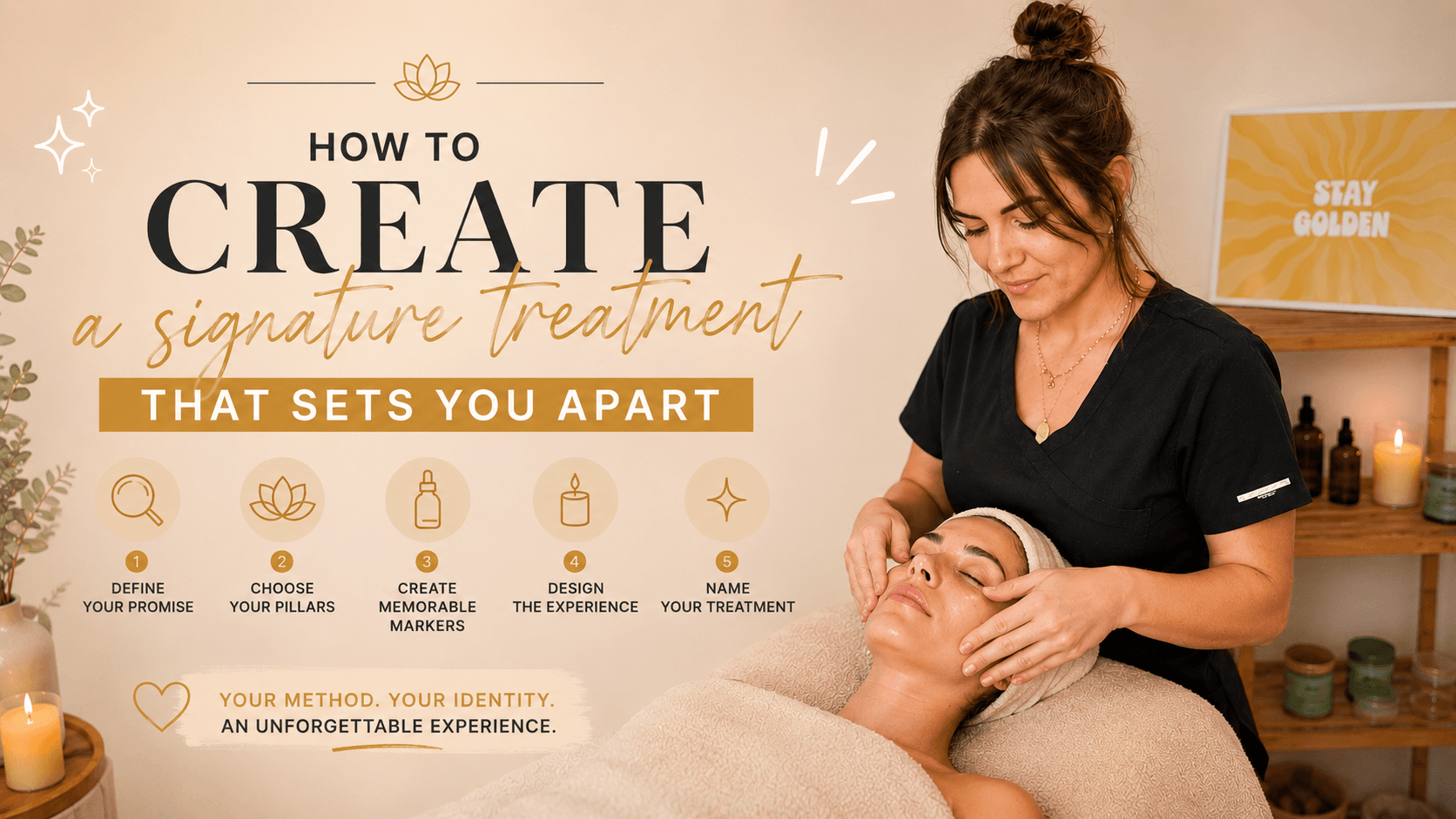
- A treatment that's yours. That's the foundation of a signature treatment, and therefore of a service no one can compare to the price of the salon next door.
- Less fatigue. Good advanced training also works on your posture, your economy of movement and your pace. After fifteen years of practice, I can tell you that's far from a detail: your hands and your back are your working tools.
- Clients who come back. A client who has experienced a genuinely personalised treatment stops looking elsewhere — it's the most solid loyalty lever there is.
How the ORA method approaches advanced facial massage
These are exactly the gaps I built the ORA Restore & Reconnect method around. For years I stacked up technical trainings, looking for the manoeuvre I thought I was missing. What changed everything was the day I stopped looking for one more movement and started preparing the ground instead: breathing, safety, observation before the first contact.
So the method brings together four things rather than a protocol: preparing the nervous system, breathing, reading the tension and emotion held in the face, and a massage built from what you've observed. The goal isn't for you to leave with my protocol. It's for you to leave able to create your own, for every client who lies down on your table.
Because no two faces tell the same story — and an advanced treatment is simply one that takes that into account.
FAQ — Advanced facial massage training
Do you need an esthetics qualification to take advanced training? Regular facial massage practice is the real prerequisite, even more than the qualification itself. Advanced modules assume the basic gesture is already there: without that foundation, you'll spend the training catching up on fundamentals instead of building on top of them. Also check your country's legal requirements for practising professionally.
How long does it take to integrate advanced training into your practice? Adjustments to pace and pressure can be felt from the very first treatments. A genuine reflex for assessment and real-time adaptation generally takes several weeks of conscious practice — which is why being able to return to the content during that period matters more than cramming everything into two intense days.
Is online training as good as in-person training? For fine correction of the gesture itself, in person keeps a real advantage. For everything that belongs to the method — assessment, regulation, protocol building, adaptation — online is often better, because it allows repetition and a return to the content at the moment the question actually comes up in the treatment room.
How can you tell whether a training is truly "advanced" and not just another protocol? Look for an assessment module in its own right, explicit work on regulating the nervous system, and whether you come out able to build your own protocols. A training that only teaches a sequence to reproduce identically is one more protocol, whatever it's called.
Can you raise your prices after advanced training? Yes — provided the content of the treatment genuinely changes and you can explain it. What the client pays for isn't your certificate: it's a visibly different, personalised experience. The training gives you the substance; your positioning is what turns it into a price.
Going further
If you recognised yourself in the signs at the start of this article, what you probably need isn't one more technique — it's a framework for using the ones you've already mastered. That's the whole logic behind the ORA Restore & Reconnect training.
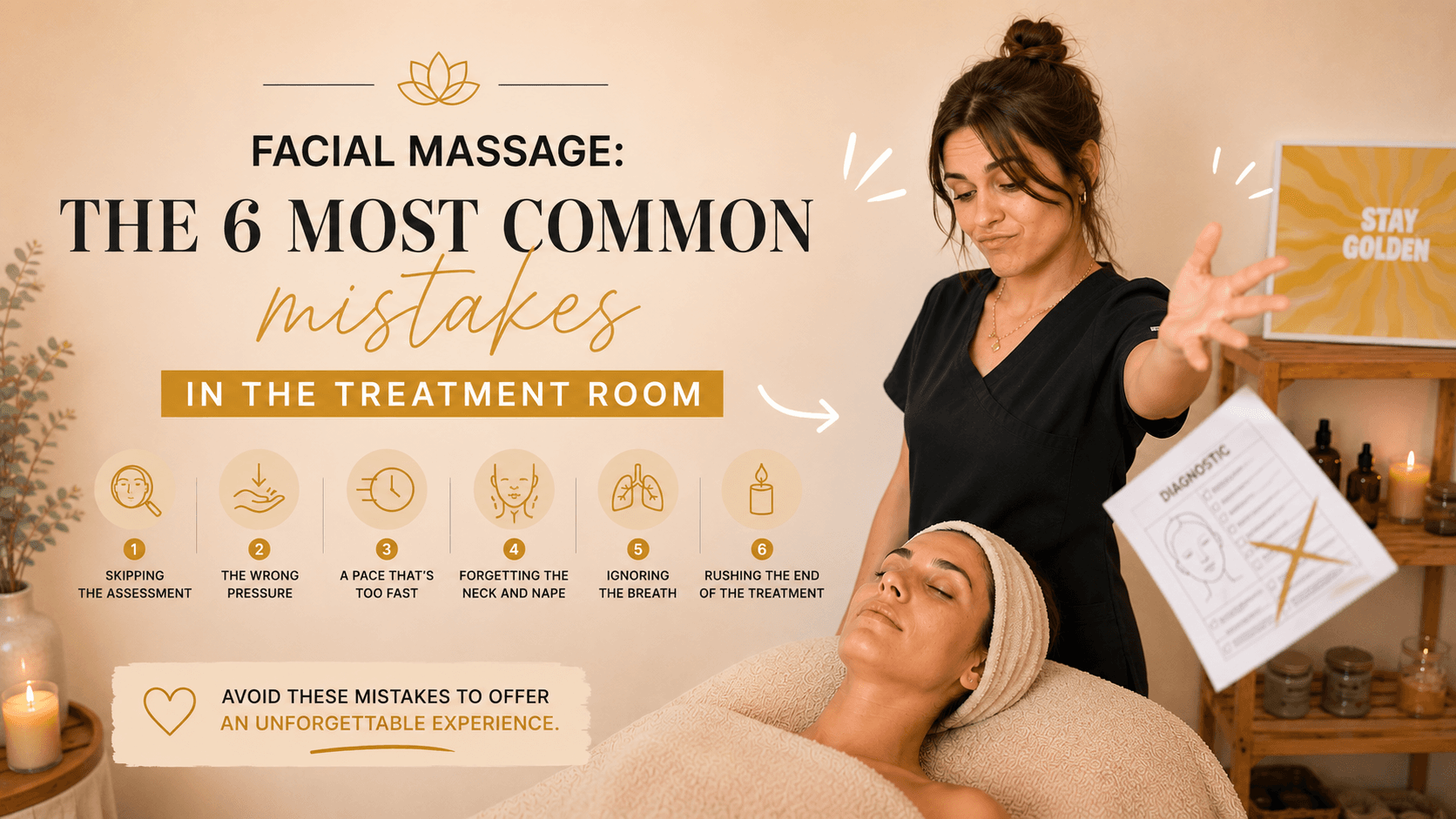
To get started today, get the free guide: 5 keys to immediately transform your clients' experience. And if you want a concrete starting point, revisit the 6 most common facial massage mistakes — fixing those is often the real first "advanced" level.